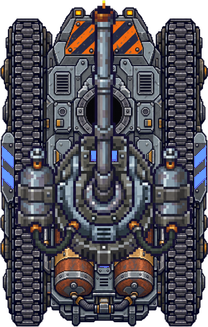
Drake Flame Tank
Pours fire in bursts, and the ground it washes over keeps burning under friend and foe alike. Paper-thin and short-armed: it is meant to be spent.
Stats
- Tier
- Tier 2
- Cost
- 400 metal
- Build time
- 16 s
- Hit points
- 260
- Armor
- Medium
- Speed
- 2.3 tiles/s
- Unit cap
- 2
- Vision
- 6 tiles
- Power
- −2
- DPS
- 90
- Range
- 4 tiles
- Built at
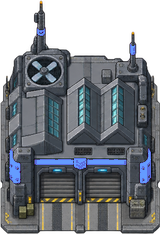
- Advanced War Factory
 Arsenal
Weapons
Flamethrower
- Damage
- 7.8 ×30
- Reload
- 2.60 s
- DPS
- 90
- Range
- 4 tiles
- Splash
- 38 px
- Traits
- Aimed from a mount that turns on its own: the unit fires in any direction without turning its hull, and can keep firing on the move. A fixed gun has to face its target first.
- vs Light
- ×1.50
- vs Medium
- ×1.10
- vs Heavy
- ×0.45
- vs Structure
- ×1.30
- vs Ship
- ×0.50
Counters
- Light
- Effective against: ×1.50; Countered by: ×1.10
- Medium
- Effective against: ×1.10; Countered by: ×1.10
- Heavy
- Effective against: ×0.45; Countered by: ×1.30
- Structure
- Effective against: ×1.30; Countered by: ×1.30
- Ship
- Effective against: ×0.50; Countered by: ×1.10
- Submarine
- Effective against: —; Countered by: ×1
- Aircraft
- Effective against: —; Countered by: ×1.40
The Drake's weapon does not fire, it pours. Hold it on something and it throws burning fuel for a full second, a continuous tongue of flame rather than a line of shells, and then the bottles are empty and it needs 2.6 seconds to come back up to pressure. What the jet washes over keeps burning for eight seconds after that, and that is the unit: it denies ground rather than killing what stands on it.
It is also thin-skinned: 260 hit points is less than a Wolf carries at Tier 1, its reach of four tiles is a light tank's and no more, and it has nothing at all for aircraft. It is priced to be spent, and it comes early: a Tier-2 unit with no radar behind it, on the field while its prey is still soft.
Quote
| Operation | Voice lines |
|---|---|
| Selection | Ready to turn up the heat. |
| Movement | Bringing the heat along. On our way. |
| Attack | Let's warm them up. Engaging the target. |
| Hold / stop | Holding position. |
| Board / pick up | Moving to board. |
| Protect / escort | We've got your back. |
Trivia
-
The flame tank was always a short-range bargain. The British Churchill Crocodile of 1944 towed a seven-ton armoured trailer of fuel behind it and could throw flame about 110 metres; the crews' worry was never the range but what was in the trailer. The American M67 "Zippo" in Vietnam carried its fuel inside the hull instead, which was tidier and no more comforting.
What made them worth building was rarely the killing. A bunker that had ignored artillery all morning tended to surrender to the first jet that touched its firing slit, and the ground in front stayed unusable long after the tank had gone.
-
On October 6, 2026, the Drake slowed from 84 to 73.6 movement speed. It also takes only half the usual damage from burning ground, useful for a vehicle that leaves fire behind it.
Last edited