
Economy and power
Metal, power, selling and refunds: the numbers that decide how fast your base runs.
Steel Tide has two resources. Metal is what you spend; power decides how fast you can spend it.
Metal
- Metal comes from extractors on deposits. A Metal Extractor mines 1.4 metal per second; the Advanced Extractor mines 3 metal per second on the same deposit, and the Deep-Core Extractor mines 8. These are base rates before income bonuses, damage and power shortages.
- Each completed Headquarters also produces a base rate of 0.5 metal per second, with the same income, health and power modifiers. This provides a way to rebuild when all extractors are lost and your treasury is empty.
- An extractor that drops below half its health mines at half its rate until an engineer mends it back to at least half. A raid does not have to kill an extractor to cost you metal, and the selected extractor's card shows what it is actually mining.
- There is no storage cap. Extractors provide the income that lets your economy grow.
- Conquest matches start with 600 to 10,000 metal, in steps of 100, chosen in the setup screen.
| Weapon | Cost | Build time | Hit points | Power | Mining | Upgrade |
|---|---|---|---|---|---|---|
 | 2500 | 60 s | 4000 | +10 | +0.5 | 15000 metal · 180 s |
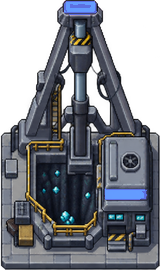 | 120 | 10 s | 600 | −4 | +1.4 | 190 metal · 16 s |
 | 310 | 26 s | 950 | −8 | +3 | 500 metal · 30 s |
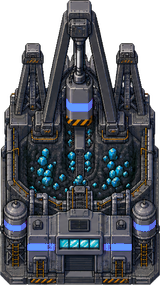 | 810 | 56 s | 1700 | −15 | +8 | — |
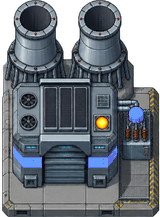 | 140 | 12 s | 500 | +20 | — | 260 metal · 18 s |
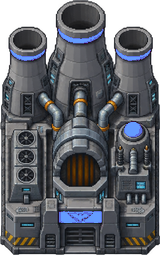 | 400 | 30 s | 900 | +50 | — | 700 metal · 36 s |
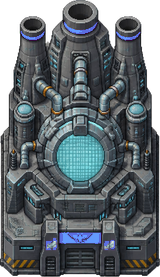 | 1100 | 66 s | 1800 | +150 | — | — |
Power
Power plants produce; everything else draws: every building, and every unit, as much as it counts in population. A Wolf draws 1, a Bison 2, a Mammoth 4, so an army is a load on the grid the way a base is, and it grows with the army.
The grid loses some of what the plants make before it reaches anything, and the loss grows with the square of the load:
grid losses = round(load² ÷ 600)
A base drawing 60 loses 6; one drawing 150 loses 38; one drawing 300 loses 150, a second grid's worth. Every unit and building you add costs a little more power than the last, and the faction that has everything pays the most for its next tank. The power strip shows the supply after the losses against the load; the breakdown behind it lists the losses as a line of their own.
As long as the supply covers the load nothing changes. The moment it does not, the base runs at a power factor:
power factor = min(1, max(0.35, supply ÷ load)), where supply = max(0, generation − losses)
The factor multiplies the speed of production, turret fire, mining and repair towers, and the Radar Station loses range. Units feel it too: a brownout slows every unit you own to 1 − (1 − factor) ÷ 2 of its speed; at the 35 % floor an army still moves at two thirds of its pace. A base at 50 % power builds tanks at half speed, its turrets fire at half rate and its tanks drive at three quarters. The floor is 35 %, so a base never stops entirely, but a serious deficit costs more than any single building is worth.
Selling and refunds
- Selling a building returns half its cost, scaled by remaining health, with a minimum refund of one eighth of the full price. The final refund is rounded down.
- Cancelling construction refunds 95 % of what has been paid so far.
- Cancelling production refunds what the unit in progress has consumed; units still waiting in the queue have cost nothing yet.
Population
Each unit costs population; the cap is set at match start from 50 to 300 in steps of 10, with 100 as the default. Heavier units cost more, so late in a game the cap nudges armies toward quality over quantity.
Repair
Engineers repair buildings (the one they are ordered onto, or, left idle, whichever damaged one is in sight of where they stand) and a Repair Tower heals up to three allied units or completed buildings in range at a time. Towers and recovery vehicles do not repair themselves or other repair-aura sources. Neither is free: each point restored costs a share of the target's price per point of health, 35 % under an engineer's hands and 25 % from a tower, so a full mend is always cheaper than a new one but a camp taking fire is a running bill. Both slow down with the power factor, so a base in deficit also recovers slower between attacks. An engineer with its hands on a building, raising or mending it, is what enemy guns turn to first.
Last edited